By Geoff Trensky
Art in healthcare environments is often understood in terms of expression, identity, and emotional connection. These are important contributions. But there is another, quieter role – how art helps people understand a place.
In healthcare settings, where environments are often complex and emotionally charged, this role becomes particularly significant.
Most people don’t experience environments as plans or diagrams. They read them in real time, using cues that help them make sense of where they are, where they need to go, and what is expected of them. In this way, environments either support intuitive use, or require effort to interpret.
Art in healthcare environments can play a subtle but powerful role in this process.
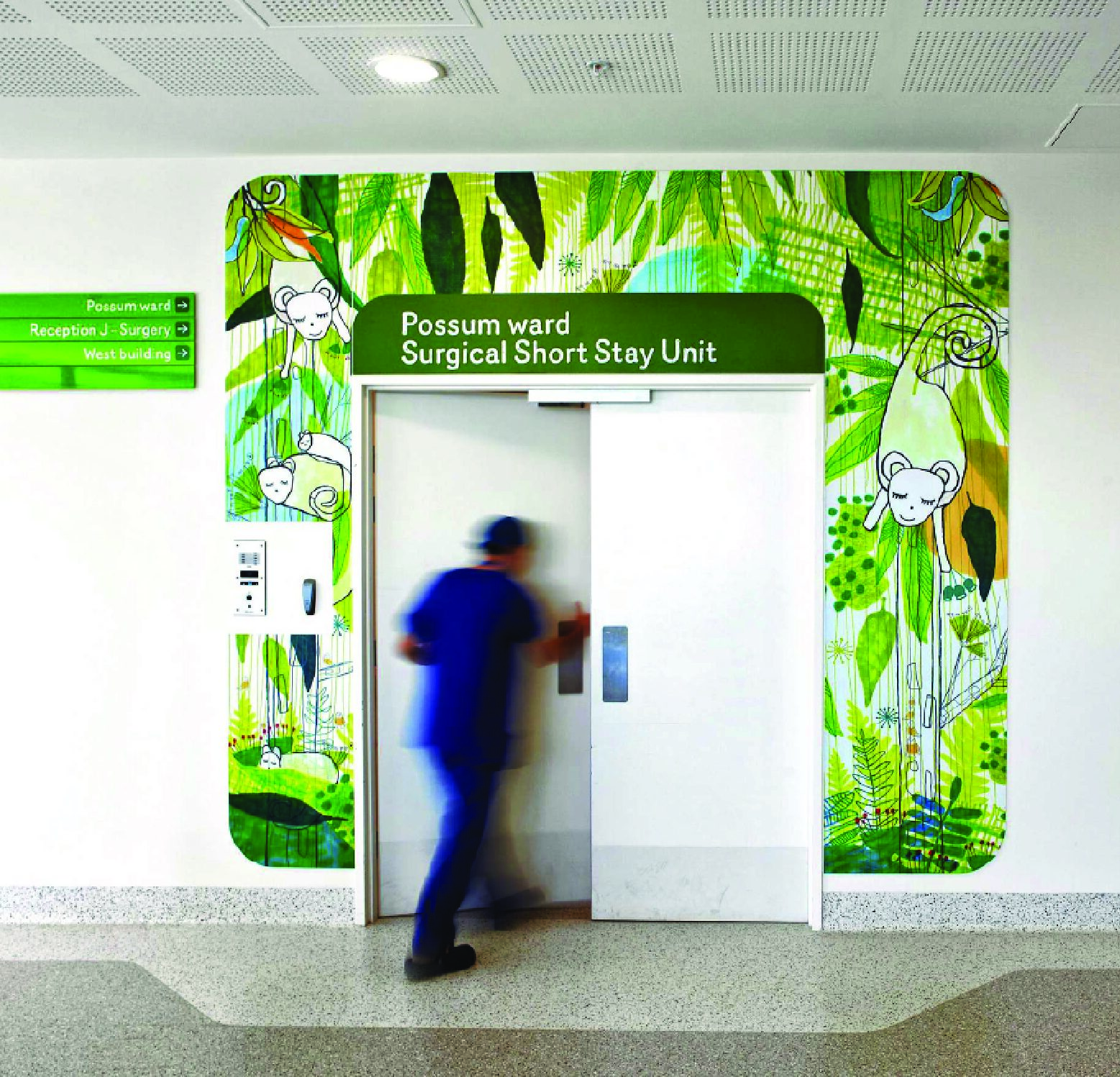
In many settings, moments of art become reference points, anchoring memory, aiding orientation, and helping people recognise where they are. A distinctive installation, a change in colour or material, or an integrated artistic gesture can signal a transition, mark a destination, or reinforce the identity of a space.
When these cues are present, people tend to move with greater confidence. They don’t need to stop and think about how the place works. The environment begins to explain itself.
This has a direct impact on wellbeing.
When people have to work to interpret their surroundings particularly in unfamiliar or complex environments, it increases cognitive load. That effort may be small in isolation, but it accumulates over time. Over time, this can lead to hesitation, stress, and a sense of disorientation.
Conversely, when environments are easy to read, people feel more at ease. They can focus on their purpose rather than navigating the space. Movement becomes more natural, and the experience of being there becomes calmer and more comfortable.
This becomes particularly important in hospitals.
Hospitals are complex places where people often arrive already under stress. In these moments, the ability to quickly understand where to go and what to do can significantly affect how a person feels.
While signage plays an important role, it is often the environment itself that carries the greatest load. Subtle cues, colour, light, material, and artistic or creative interventions can help distinguish departments, signal purpose, and create clarity.
A maternity ward, for example, might express warmth and new life, while imaging or emergency areas may communicate precision and urgency. These cues don’t need to be explicit, but when they align with expectation, people recognise them instinctively.
The result is not just better navigation, but a more supportive experience.
When a place makes sense, it is easier to feel comfortable within it. When people feel comfortable, it becomes easier to feel they belong.
This potential is not automatic. For art in healthcare environments to contribute in this way, it needs to be considered as part of how a place works not simply added at the end. This requires clarity of intent: how should the environment support movement, understanding, and behaviour?
When artistic and creative interventions are integrated with these questions in mind, they can reinforce legibility and experience. When they are not, they risk becoming decorative rather than contributing meaningfully to how the environment is understood.
This suggests that art in healthcare environments has a broader, more functional role to play. Not only as something we engage with, but as something that contributes to how environments work shaping movement, supporting understanding, and reducing the effort required to be there.
We often think of art as something we notice. But some of its most important work is quieter helping a place make sense, so people can simply get on with being there.
Find out more:
perimeterdesignconsultancy.com
www.linkedin.com/in/geofftrensky
Photo Credit: Fraser Marsden Photographer
Written by Geoff Trensky.
Posted by Elyssa Sykes-Smith.
-
Geoff Trensky is a multidisciplinary design strategist and wayfinding specialist with over 40 years’ experience. His work focuses on creating legible environments that improve how people understand, navigate, and experience complex spaces.
-
Elyssa Sykes-Smith is a multidisciplinary artist, educator and researcher, and Media Officer at AHNNA.